Organization of State Mental Health Agencies, 2025
State Mental Health Agencies (SMHAs) are responsible for administering over $55 billion each year to provide mental health services to more than 8.4 million individuals. SMHAs vary widely in how they are structured within state governments, how they organize and oversee the delivery of mental health services, and the specific types of services for which they are responsible. The organization and responsibilities of SMHAs are also regularly modified. For example, as of July 1, 2025, two states (Illinois and South Carolina) are restructuring their SMHA and combining mental health (MH) and substance use disorder (SUD) service responsibilities within a single agency.
Disability Responsibilities of SMHAs
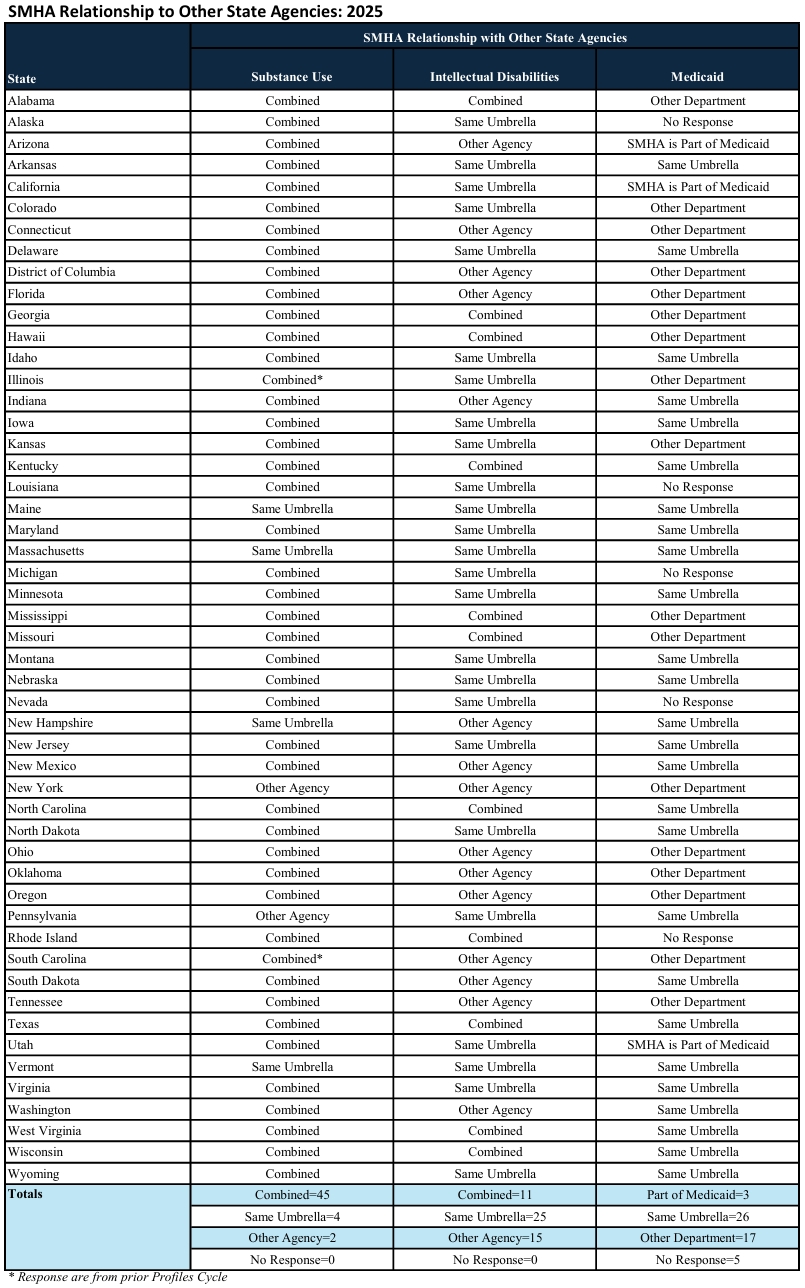
In most states, the SMHA is a combined agency responsible for providing services beyond MH. In 45 states, responsibility for both MH and SUD are combined into a single state agency. MH and SUD services are located within the same state umbrella agency in seven additional states. In eleven states, the same agency is responsible for providing intellectual and developmental disability (IDD) services along with MH and SUD (see Figure 1 and Table 1).

Most states that have combined MH and SUD into a single behavioral health agency have also combined planning, data systems, financing, and licensing for MH and SUD services.
- In four states, all behavioral health providers funded by the SMHA provide both MH & SUD services, while in 35 states some, but not all of their funded providers deliver both MH & SUD services
- 30 states have a combined planning process for MH & SUD
- 28 states have a combined funding system for MH & SUD services
- 24 states use the same data/IT system for both MH & SUD
- 21 states have a combined licensing system for MH & SUD services

SMHA Location in State Government
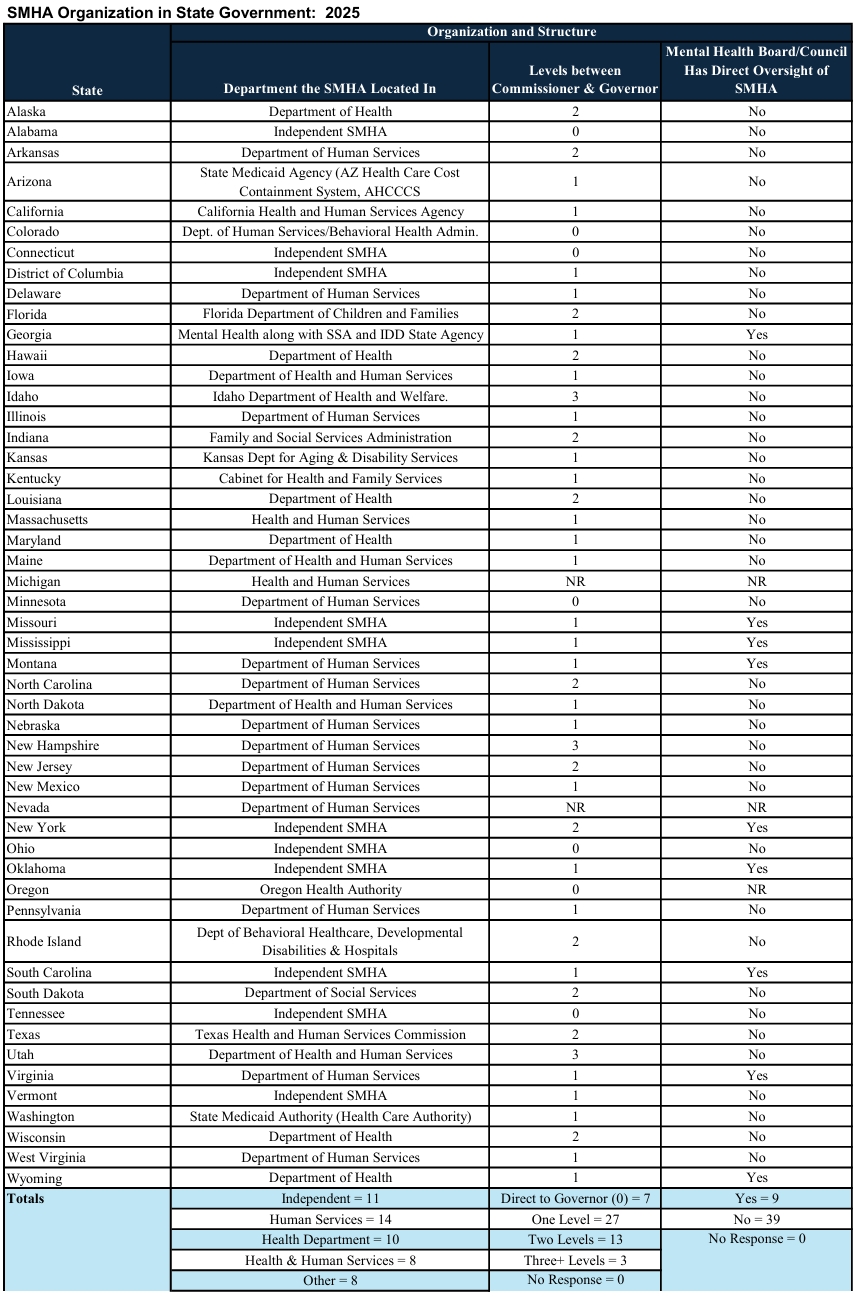
SMHAs are most often administratively located within a larger umbrella human services agency. In 2025, 16 SMHAs were located within state Departments of Human Services or Departments of Social Services, 10 SMHAs were in Health Departments, three were located in the Medicaid Authority, 8 were in a Department of Health and Human Services, and 6 SMHAs were located in some other state department. Eleven SMHAs were either independent state Departments of Mental Health, Department of Behavioral Health (combining mental health and substance use services) or Departments of Behavioral Health and Intellectual Disability (see Table 2). The SMHA Director is a member of the Governor’s Cabinet in 12 States (AL, CT, GA, ID, MN, MO, ND, NE, NY, OH, RI, and TN). In seven states, the SMHA Director reports directly to the Governor, while in 27 states the SMHA’s Director reports to a department head, with one level between the SMHA’s Director and the Governor. In 13 states, there are two levels between the SMHA leader and the Governor, and in three states there are three or more levels between the SMHA and the Governor. In 9 states, a Mental Health (or Behavioral Health) Board or Commission is charged with direct oversight of the SMHA (GA, MO, MS, MT, NY, OK, SC, and WY).
Reorganization of SMHAs
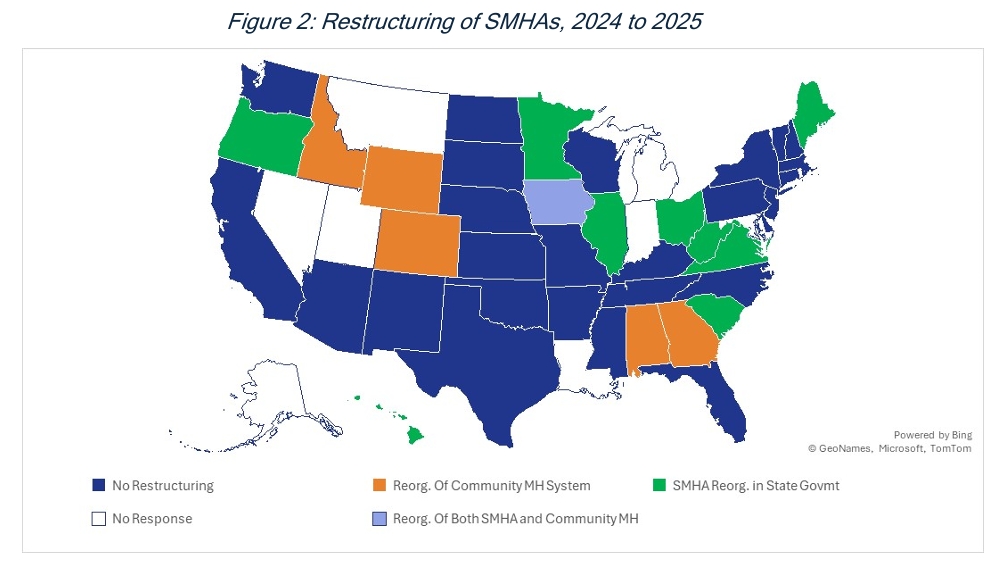
Since 2023, 29 percent of SMHAs have been reorganized. In 12 states, the reorganization involved moving the location of the SMHA within state government (AR, HI, IA, ID, IL, ME, MN, OH, OR, SC, VA, and WV). In five states, the reorganization involved modifying how the SMHA works with community mental health providers, including shifting to Certified Community Mental Health Centers (CCBHCs), or other service financing models (see Figure 2). While not restructuring their community provider system, 19 states reported initiatives to reduce barriers to services and/or increase individual choice in mental health services.
SMHA Responsibilities for Specific Mental Health Special Services and Populations
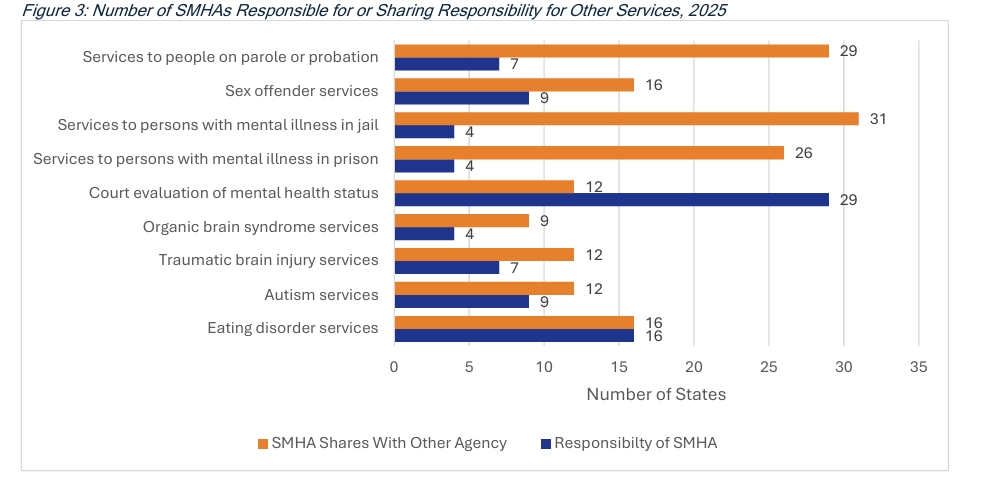
SMHAs vary widely in the specific services and population groups for which they are responsible. In most states, services for children and adolescents are part of the SMHA’s responsibility, but in seven states (CT, DE, NH, NM, NJ, RI, and OR) child and adolescent mental health services are in the responsibility of an agency separate from adult mental health. SMHAs are often responsible for related disability services, such as Traumatic Brain Injuries, Organic Brain Syndrome, Autism, Eating Disorders, and Criminal Justice system-related mental health services (Figure 3).
State Agency Responsible for the Operation of State Psychiatric Hospitals
The majority of SMHAs were responsible for both the oversight and management of state psychiatric hospitals and community mental health services. However, in 12 states (AZ, CA, CO, MD, ME, MI, MT, NH, NJ, NM, WA, and WV), responsibility for operation of state psychiatric hospitals was in a different state agency than the SMHA overseeing community mental health services. In July 2025, Minnesota is shifting state hospital oversight to a new separate state agency.
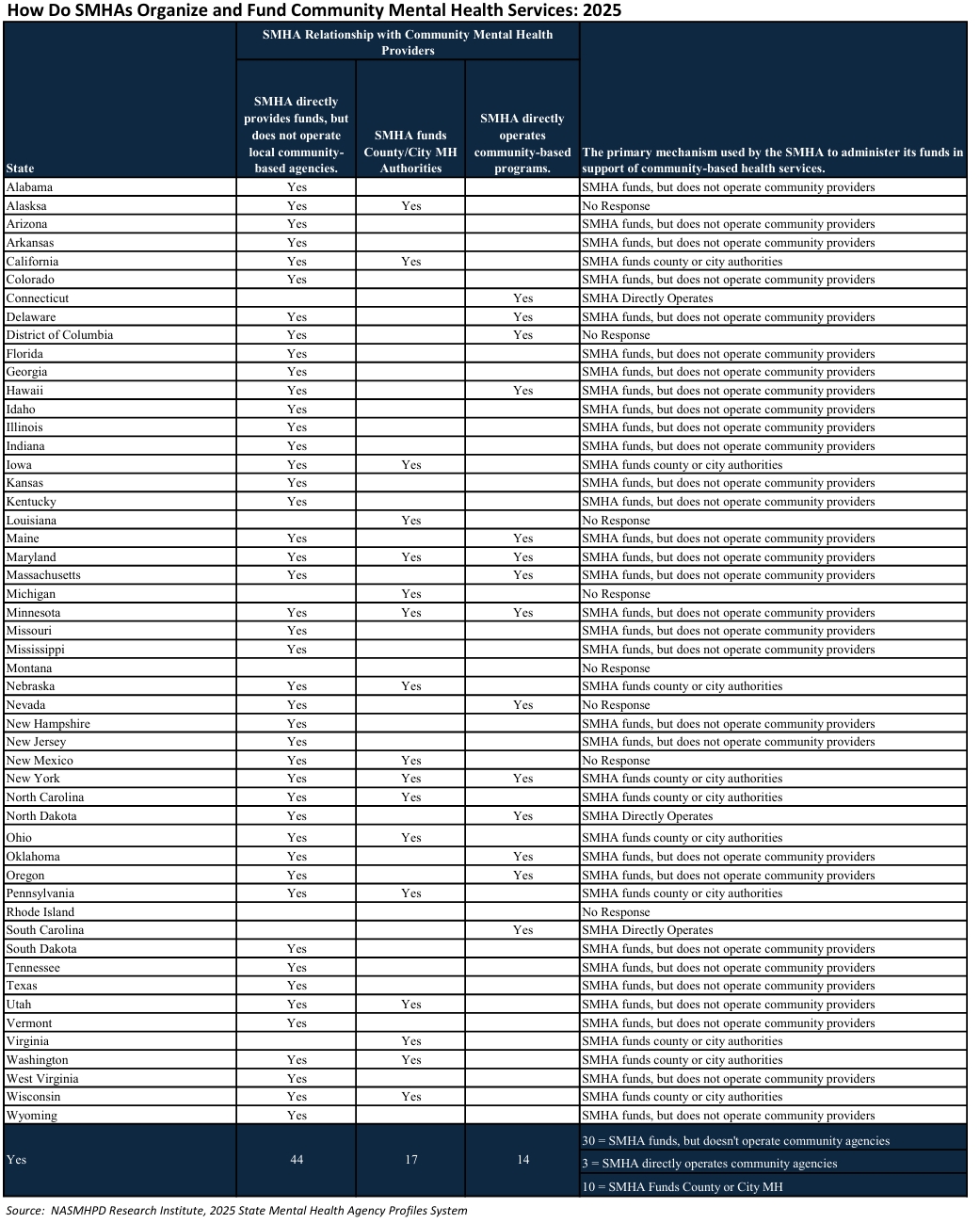
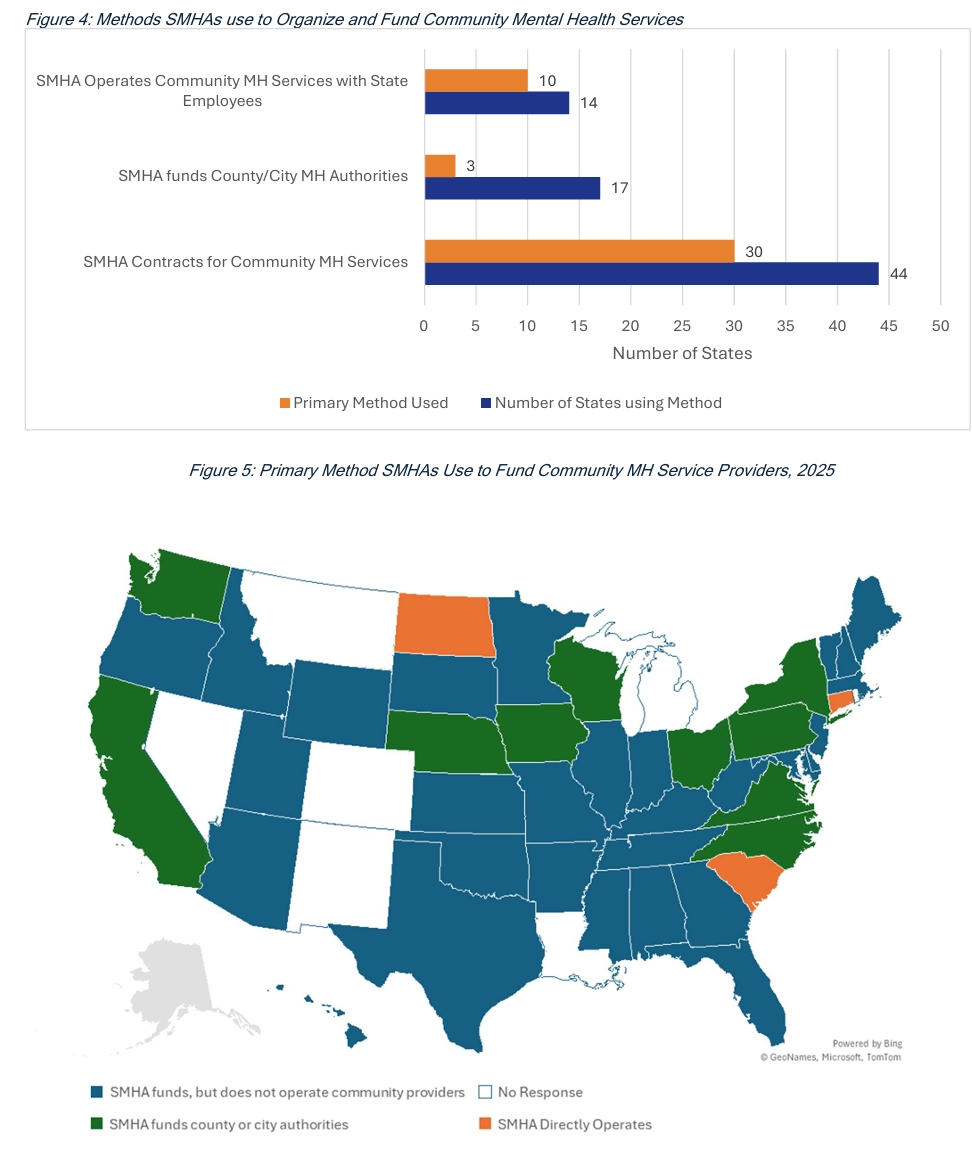
SMHA Responsibilities for Community Mental Health Services: In 2023, SMHAs expended over $35.6 billion (70% of their expenditures) on mental health services provided in communities to more than 8 million individuals. SMHAs vary by the methods they use to coordinate and distribute these resources. There are three major methods used by SMHAs to provide community mental health services: Providing them with state employees in state operated community providers, funding county or city (or regional) mental health authorities, or directly contracting with community providers (often not-for-profit providers) (see Figures 4 and 5 and Table 3).
SMHA Role in Licensing or Certification of Mental Health Providers
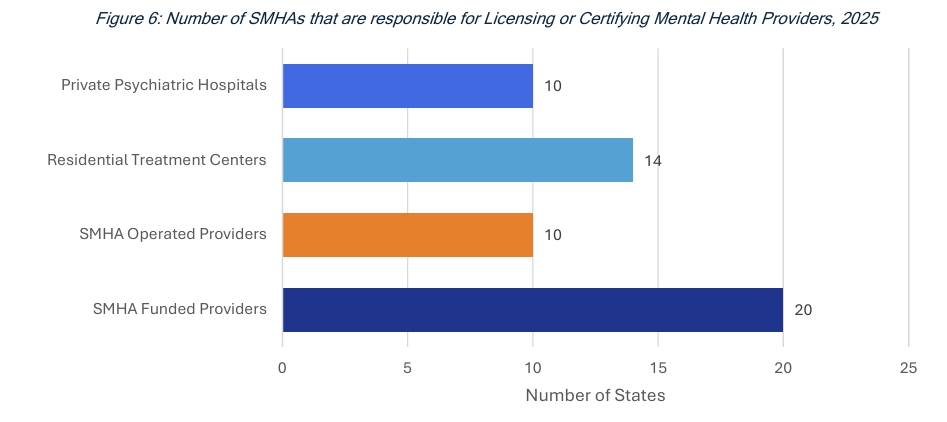
In 20 states, the SMHA is the state agency charged with licensing or certifying SMHA-funded mental health providers (See Figure 6)